
Department
Project academic year
Abstract
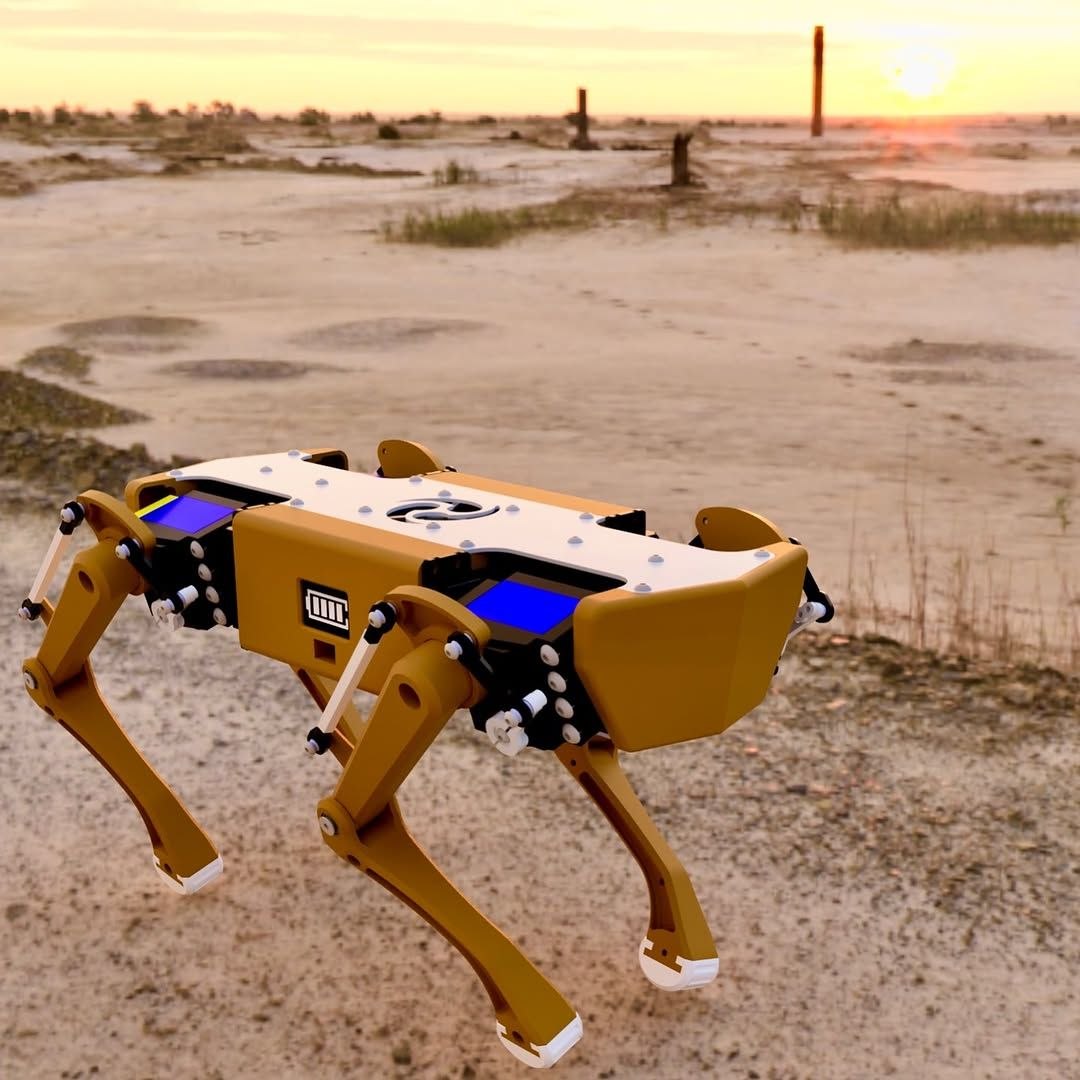
Unmanned ground vehicles often struggle to navigate rough or unstructured terrain, making legged systems a superior alternative for complex environments. This project presents the end-to-end design and implementation of a four-legged (quadruped) robot engineered for stable locomotion across uneven surfaces. The mechanical frame was developed using CAD software and light-weight, high-strength materials to optimize payload efficiency and mobility. Each leg features 3 degrees of freedom (DOF), driven by high-torque servo motors to enable fluid, multi-directional motion.The embedded control architecture utilizes a central microcontroller paired with an Inertial Measurement Unit (IMU) to provide real-time attitude sensing and feedback. Inverse kinematics (IK) algorithms are implemented alongside rhythmic gait patterns—such as trot and walk gaits—to ensure dynamic balance and stability. Physical testing demonstrates that the system achieves smooth step execution, effective body stabilization against moderate disturbances, and reliable locomotion over obstacles. This design serves as a scalable foundation for applications in search-and-rescue, environmental monitoring, and hazardous area inspection.
الكلمات المفتاحية
robot
Quadruped
arduino
raspberry pi
ROS
Project Poster
Project students