Home Page

COMPOUND DIE DESIGN AND MEASUREMENT OF METAL PRODUCT DEFORMATION USING ANSYS SOFTWARE

Project academic year
Abstract
This project presents the design of a compound die and investigates the resulting burr heights of metal parts using theoretical and numerical approaches. The die was designed based on standard mathematical equations to perform blanking and piercing in a single press stroke, producing an exhaust gas recirculation (EGR) plate from four sheet materials (AISI 1006, AISI 1018, AISI 304, and AISI 202) with 2 mm thickness. The cutting process was simulated using the finite element method (ANSYS Explicit Dynamics) to evaluate directional deformations at the cutting edges, representing burr heights, under varying sheet thickness, clearance, cutting speed, and blank holder force. Results showed that a flat piercing punch produced the maximum burr heights for AISI 1006 and AISI 304, while for AISI 1018 and AISI 202, burr heights increased with smaller thickness and higher cutting speed, with the best cutting quality achieved at a low speed of 30 m/s. The study provides a validated compound die design procedure and shows how process parameters can be optimized to minimize burr heights and improve product quality for ferrous and stainless steel sheets.
الكلمات المفتاحية
Compound Die
Burr Height
Sheet Metal Cutting
Finite Element Method (FEM)
ANSYS Explicit Dynamics
Blanking and Piercing
Cutting Clearance

GENERAL PURPOSES OF ROBOT ARM

Project academic year
Abstract
Today, technology is developing rapidly in line with increasing human needs. The work carried out to meet these needs makes life easier every day, and much of this effort is concentrated in robotic arm research. Robot arms operate either under the control of an external user or by executing predetermined commands. Nowadays, the most advanced applications of robot arms are found in the industrial and medical sectors. The robot arm assembled and realized in this project has the ability to move along 6 axes using 6 servo motors. Using its gripper, it can pick up the desired material from one location and carry it to another, as well as mix it with the material it holds. Robot control is provided by connecting the system to an App Controller linked to an Arduino Mega microcontroller.
الكلمات المفتاحية
Robotic Arm
6-DOF Manipulator
Servo Motor
Arduino Mega Microcontroller
Forward and Inverse Kinematics
Mechanical Design
Robot Control

Blanking die design and stress analysis using FEM

Project academic year
Abstract
This project investigates the design of a blanking die and analyzes the stresses generated during sheet metal cutting using theoretical and numerical approaches. The blanking die was designed using standard mathematical equations, and the cutting process was simulated using the finite element method (ANSYS Explicit Dynamics) to evaluate stresses on the blanking punch. The aim was to develop an optimized die model that ensures high cutting quality with minimal burr formation and reduced stress concentration at the cutting edges, thereby extending die life and lowering manufacturing costs. The simulation evaluated three sheet materials—AISI 1006 steel, AL6061-T6 aluminum alloy, and tungsten—by determining the equivalent (von Mises), maximum shear, and normal stresses at the cutting edge. Results showed the highest equivalent stress in tungsten (1713.3 MPa), followed by AISI 1006 steel (1360.2 MPa) and AL6061-T6 (572.16 MPa), confirming that material type and cutting speed significantly affect the induced stresses and deformation, with an optimal cutting speed existing for each material. The study provides a validated die design and stress-prediction procedure to guide material and parameter selection for improved die performance. Future work is recommended to extend this approach to compound and combination dies for double cutting or combined cutting-and-forming operations.
الكلمات المفتاحية
Blanking Die
Finite Element Method (FEM)
ANSYS Explicit Dynamics
Stress Analysis
Sheet Metal Cutting
Von Mises Stress
Cutting Speed

Design of Compound Die and Measurement of Burr Heights Using Theoretical and Simulation Approach

Project academic year
Abstract
This project investigates the design of the compound die and measures the burr heights using theoretical and numerical methodologies. The main aim of the project is to obtain the optimum design of the compound die with its cutting tools and to improve the cutting quality of ferrous products. The model of the compound die is designed using standard mathematical equations. It is used to produce an exhaust gas recirculation plate. Finite element technique (ANSYS software) has been used to achieve the research objectives. ANSYS is used to simulate the cutting operation and to analyze the sheet material deformation (burr heights). The final results indicate that the proposed design of the compound die can provide a clean cutting surface of the product under minimum burr height and implement the double cutting operation using the developed compound die without failure. The current project provides a better prediction of burr heights and efficient use of compound dies. The outcome indicates that the burr heights of the final product are at a smaller size for ferrous sheet materials. The findings provide optimum design and developed models of the compound die, improved product quality, and the lowest burr heights.
الكلمات المفتاحية
Compound Die
Burr Height
Sheet Metal Blanking
Finite Element Analysis (ANSYS)
Cutting Clearance

Smart Food Recognition and Nutrition estimation based on learning approaches.

Project academic year
Abstract
The proposed Smart Food Recognition and Nutrition Estimation System introduces an AI-driven approach for automated food analysis and nutritional assessment. A) Ingredient Segmentation: Rather than relying on image-level food classification, the system employs semantic segmentation to identify and separate multiple food ingredients within a single meal image at the pixel level. B) Multi-Scale Feature Extraction: An Encoder - Decoder architecture is enhanced with a deep backbone network and an Atrous Spatial Pyramid Pooling (ASPP) module to capture food ingredients of different sizes and spatial characteristics. C) Attention-Based Feature Enhancement: Squeeze-and-Excitation (SE) blocks and Global Pyramid Attention (GPA) modules are integrated to emphasize important features and improve segmentation quality. D) Automated Nutrition Estimation: After ingredient recognition, the detected classes are matched with nutritional records obtained from the USDA FoodData Central database to estimate calories, proteins, carbohydra
الكلمات المفتاحية
Deep Learning

Enhancing Communication Reliability in High – Speed Train Networks Using Intelligent Reflecting Surfaces (IRS)

Project academic year
Abstract
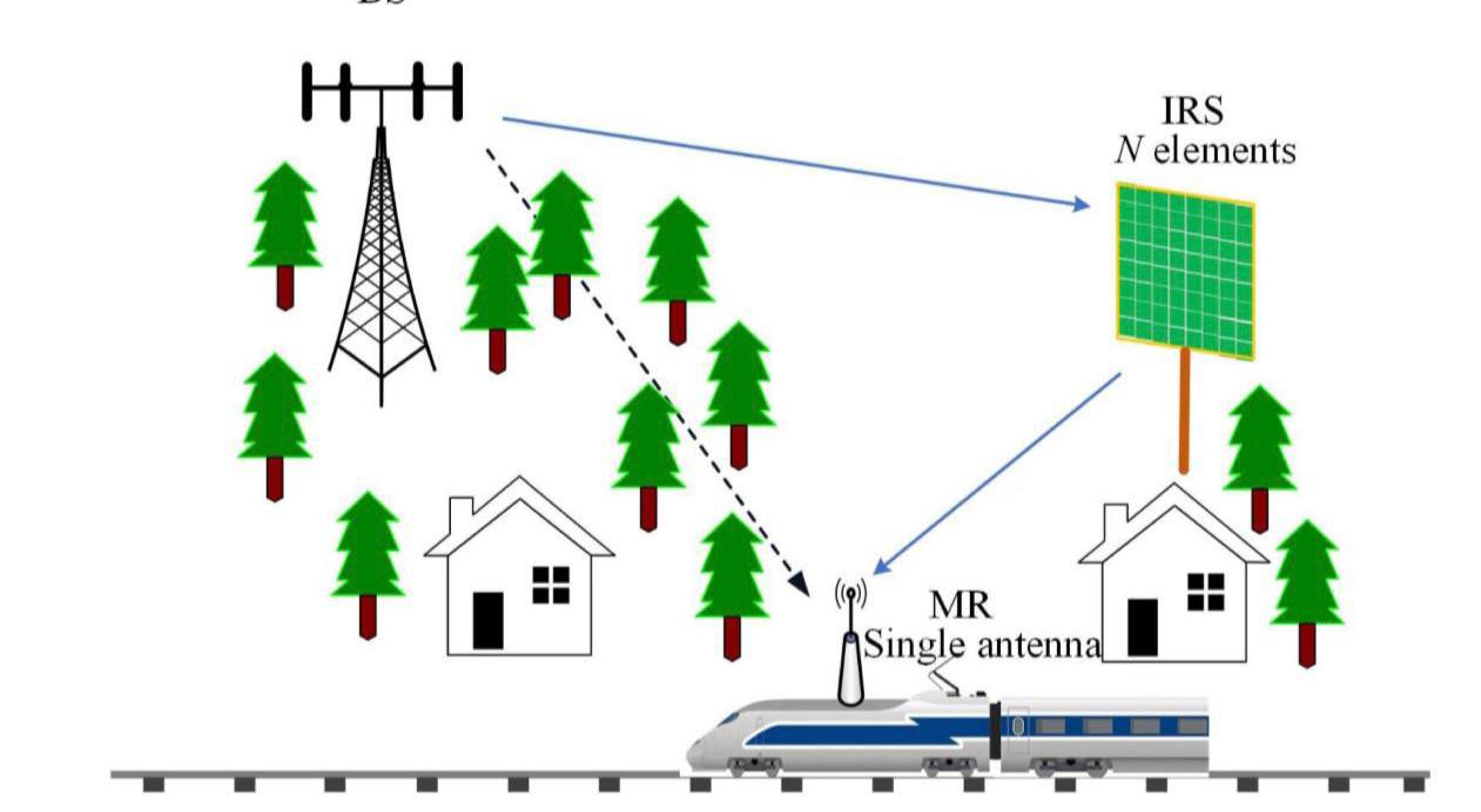
High-speed train (HST) networks experience severe communication reliability degradation due to extreme mobility, rapid time-varying channels, severe Doppler shifts, and frequent signal blockages caused by railway infrastructure. To overcome these critical propagation barriers, this graduation project investigates the utilization of Passive Intelligent Reflecting Surfaces (IRS) to dynamically reconfigure the wireless environment and enhance link reliability. A comprehensive multi-user wireless communication system is proposed, featuring a Base Station (BS) equipped with eight transmitting antennas (S = 8) serving two groups of users organized into distinct clusters, with each user utilizing eight receiving antennas (P = 8). To optimize spectral and energy efficiency, Non-Orthogonal Multiple Access (NOMA) is implemented with three users per sub-band using a 16-QAM digital modulation scheme. The wireless links involving the IRS are thoroughly modeled under a Rician channel distribution to evaluate both Line-of-S
الكلمات المفتاحية
IRS; NOMA; HST
Project Poster
IRS wireless communication system