2025 - 2026

Developing Predictive Models for Disease Outbreaks Using AI and Big Data

Project academic year
Abstract
This project presents an intelligent web-based platform for disease outbreak prediction and personalized health analysis. The system integrates a hybrid XGBoost–LightGBM model, interactive dashboards, outbreak visualization, and a multi-agent chatbot. Developed using Next.js, FastAPI, and Supabase, the platform enables real-time monitoring, prediction, and health support. The proposed model achieved an R² value of 0.8592, demonstrating reliable predictive performance.
Full Description
In recent years, the need for intelligent web-based platforms in public health has increased due to limitations in traditional disease monitoring systems, which rely on delayed and static data. This project developed a scalable web application for disease outbreak prediction and personalized health analysis. The system was implemented using Next.js for the frontend and FastAPI for the backend, with deployment on Vercel and Hugging Face. Supabase was used for authentication and database management. A machine learning model was integrated to analyze disease data and generate predictions, while asynchronous processing and lazy loading were applied to improve performance and prevent server blocking. The system also included a multi-agent AI chatbot using the OpenAI API to provide personalized health recommendations.The proposed hybrid XGBoost–LightGBM model achieved good predictive performance with an R² value of 0.8592, indicating reliable disease outbreak forecasting capability. Results showed that the platform enabled real-time visualization, efficient data processing, and improved user interaction through dashboards and alerts. The proposed system provides an effective and scalable solution for combining outbreak monitoring withIindividualIhealthIsupport.
Keywords
Big data
AI
disease monitoring system
health care
Project Poster
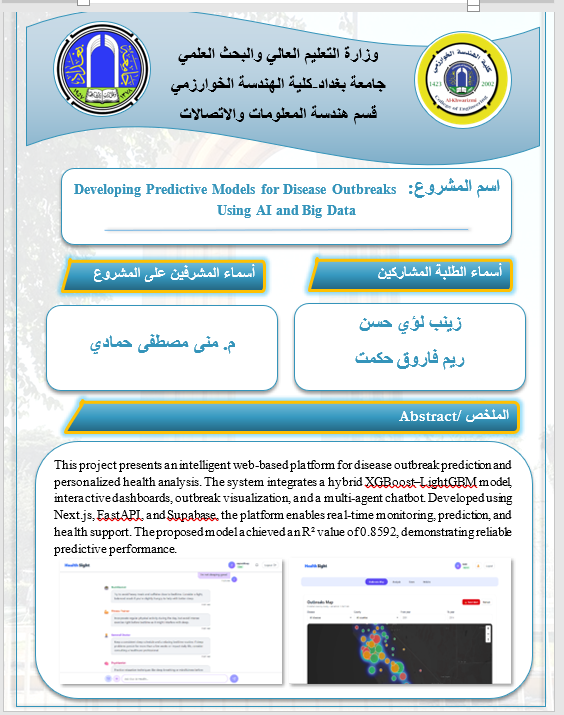
project pooster

Design of Natural Hybrid Composite for Prosthetics Denture

Project academic year
Abstract
This study investigates the design and evaluation of a natural hybrid nanocomposite material based on polymethyl methacrylate (PMMA) reinforced with hydroxyapatite (HA) and eggshell powder (ESP) for use as a prosthetic denture base material. PMMA has long been the standard material for denture fabrication due to its biocompatibility and ease of processing. However, its relatively poor mechanical properties — including low fracture toughness, brittleness, and limited flexural strength — remain a significant clinical concern. To address these limitations, natural fillers were incorporated as eco-friendly and biocompatible reinforcing agents. Four specimen groups were prepared using a cold-cure hand lay-up method: pure PMMA (control), and three reinforced groups containing 3 wt.% ESP combined with 1, 3, and 5 wt.% HA, respectively. Mechanical testing included compression, bending, and Vickers hardness tests, while physical testing covered water absorption and density measurements. Results showed that increasing HA content significantly improved bending strength — from 46.08 MPa in pure PMMA up to 71.76 MPa at 5 wt.% HA — and surface hardness, which rose from 8.14 HV to 16.00 HV. Compressive strength remained relatively stable across all groups. Water absorption was lowest in the 3HA–3ESP group (1.29%), and density increased with filler addition, peaking at 1.022 g/cm³ for the same group. These findings suggest that PMMA reinforced with hydroxyapatite and eggshell powder offers improved mechanical and physical properties, making it a promising, sustainable, and biologically compatible alternative for denture base applications.
Keywords
PMMA
hydroxyapatite
egg shell powder
denture composite

Preparation of Biodegradable Polymer Composite for bone fixation

Project academic year
Abstract
This study presents the preparation and characterization of a biodegradable polymer composite based on Polylactic Acid (PLA), Chitosan (CH), and Hydroxyapatite (HA) for potential applications in bone fixation and tissue engineering. PLA was selected as the primary biodegradable polymer matrix due to its favorable biocompatibility and biodegradability, while chitosan and hydroxyapatite were incorporated to enhance the biological and mechanical performance of the composite. Several composite formulations with different concentrations of CH and HA were fabricated using the solvent casting technique with chloroform as a solvent. The preparation process involved magnetic stirring, ultrasonic treatment, and casting in glass Petri dishes to improve homogeneity and reduce structural defects. Different experimental trials were conducted to optimize the fabrication procedure and achieve uniform composite samples with minimal air bubble formation and improved structural integrity. The prepared samples were characterized through hardness testing, surface roughness analysis, water absorption evaluation, and antibacterial activity assessment to determine their suitability for biomedical applications. The results demonstrated that the incorporation of hydroxyapatite and chitosan significantly influenced the physical and mechanical properties of the prepared composites. The sample containing 3% CH and 1.5% HA exhibited the highest hardness value, indicating enhanced mechanical stability due to the reinforcing effect of the ceramic phase. In addition, the composite containing 2% CH and 1% HA showed the lowest surface roughness value, suggesting improved filler dispersion and surface uniformity. Overall, the developed PLA/CH/HA biodegradable composites demonstrated promising characteristics for potential use in temporary bone fixation devices and orthopedic applications. The combination of biodegradability, improved mechanical behavior, and bioactive properties suggests that these composites may provide an effective alternative to conventional non-biodegradable fixation materials.
Keywords
PLA
Chitosan
Hydroxyapatite
bone fixation

simulation and practical improvement of elevator control system using Siemens plc and HMI

Project academic year
Abstract
This project focuses on the design and control of an elevator system using a Programmable Logic Controller (PLC). The primary objective is to create a reliable, efficient, and safe elevator system that operates seamlessly through PLC-based control. The elevator system is designed to serve three floors and integrates key functionalities, including floor selection, door control, and safety mechanisms. A PLC is employed to manage system operations through programmed logic, ensuring smooth movement, door control, and emergency responses. The project involves designing the mechanical and electrical components of the elevator, selecting appropriate sensors and actuators, and programming the PLC to manage these components effectively. Key safety features, such as fire protection, passenger detection, and emergency stop functions, are incorporated to ensure system reliability and user safety. The performance of the system was tested and validated practically, ensuring that it meets the required operational standards. This project provides an integrated solution for elevator control, offering insights into the practical applications of PLCs in modern elevator systems and contributing to the advancement of automation technology in building infrastructure.
Keywords
Programmable Logic Controller (PLC), Elevator Control System, and Ladder Logic Programming.

Design and Simulation of an Automated Manufacturing Line using TIA Portal, Factory I/O, Siemens PIC and Automation Studio

Project academic year
Abstract
In this study, within the scope of the graduation study in the University of Baghdad Electrical Engineering Department; an automatic control system of a production facility is designed with a PLC-based automation program. A PLC from the SIEMENS S7 1200 family was used in the automation system installed. With the new production understanding in today's industry, it has become important that production is controlled and fast. Based on this new understanding, the subject of my thesis has been determined as the design of a facility that performs the separation, processing and packaging of the produced material in a controlled manner.The production process to be designed in this facility aims to separate the products due to their various characteristics, then to process each of these products one by one, to cover the processed products by their lids, then to put each of them in boxes and leave them as a package, and each of them to be shelved one by one. Most of the manufacturing was done by robots in order to minimize human power throughout the entire manufacturing process. Likewise, errors were minimized by using robotic systems and automatic control systems in the manufacturing. This facility was programmed through TIA Portal and simulated by Factory IO.
Keywords
Programmable Logic Controller (PLC), Siemens S7-1200, Industrial Automation, TIA Portal, and Factor

Design of Compound Die and Measurement of Burr Heights Using Theoretical and Simulation Approach

Project academic year
Abstract
This project investigates the design of the compound die and measures the burr heights using theoretical and numerical methodologies. The main aim of the project is to obtain the optimum design of the compound die with its cutting tools and to improve the cutting quality of ferrous products. The model of the compound die is designed using standard mathematical equations. It is used to produce an exhaust gas recirculation plate. Finite element technique (ANSYS software) has been used to achieve the research objectives. ANSYS is used to simulate the cutting operation and to analyze the sheet material deformation (burr heights). The final results indicate that the proposed design of the compound die can provide a clean cutting surface of the product under minimum burr height and implement the double cutting operation using the developed compound die without failure. The current project provides a better prediction of burr heights and efficient use of compound dies. The outcome indicates that the burr heights of the final product are at a smaller size for ferrous sheet materials. The findings provide optimum design and developed models of the compound die, improved product quality, and the lowest burr heights.
Keywords
Compound Die
Burr Height
Sheet Metal Blanking
Finite Element Analysis (ANSYS)
Cutting Clearance

Smart Food Recognition and Nutrition estimation based on learning approaches.

Project academic year
Abstract
The proposed Smart Food Recognition and Nutrition Estimation System introduces an AI-driven approach for automated food analysis and nutritional assessment. A) Ingredient Segmentation: Rather than relying on image-level food classification, the system employs semantic segmentation to identify and separate multiple food ingredients within a single meal image at the pixel level. B) Multi-Scale Feature Extraction: An Encoder - Decoder architecture is enhanced with a deep backbone network and an Atrous Spatial Pyramid Pooling (ASPP) module to capture food ingredients of different sizes and spatial characteristics. C) Attention-Based Feature Enhancement: Squeeze-and-Excitation (SE) blocks and Global Pyramid Attention (GPA) modules are integrated to emphasize important features and improve segmentation quality. D) Automated Nutrition Estimation: After ingredient recognition, the detected classes are matched with nutritional records obtained from the USDA FoodData Central database to estimate calories, proteins, carbohydra
Keywords
Deep Learning

Enhancing Communication Reliability in High – Speed Train Networks Using Intelligent Reflecting Surfaces (IRS)

Project academic year
Abstract
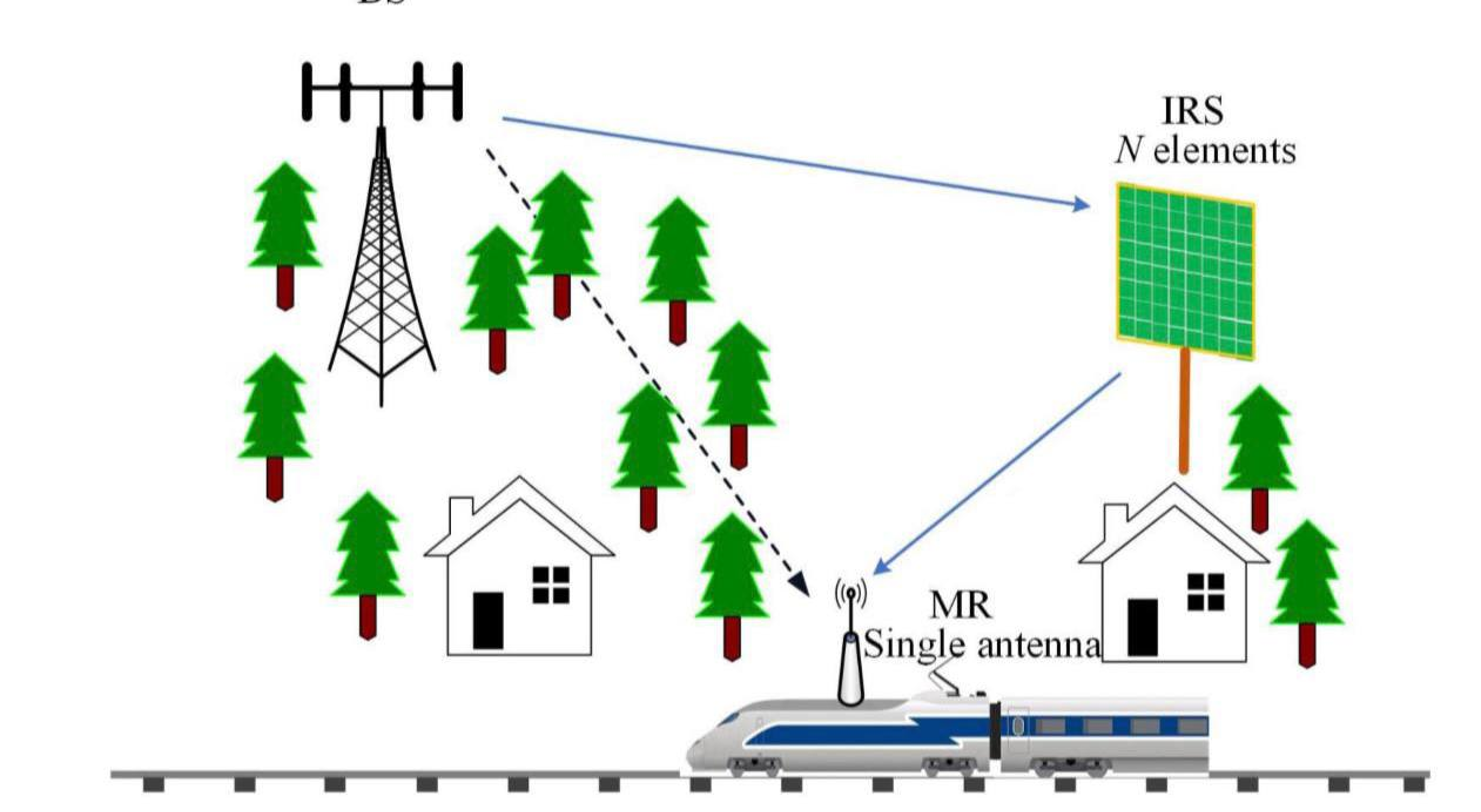
High-speed train (HST) networks experience severe communication reliability degradation due to extreme mobility, rapid time-varying channels, severe Doppler shifts, and frequent signal blockages caused by railway infrastructure. To overcome these critical propagation barriers, this graduation project investigates the utilization of Passive Intelligent Reflecting Surfaces (IRS) to dynamically reconfigure the wireless environment and enhance link reliability. A comprehensive multi-user wireless communication system is proposed, featuring a Base Station (BS) equipped with eight transmitting antennas (S = 8) serving two groups of users organized into distinct clusters, with each user utilizing eight receiving antennas (P = 8). To optimize spectral and energy efficiency, Non-Orthogonal Multiple Access (NOMA) is implemented with three users per sub-band using a 16-QAM digital modulation scheme. The wireless links involving the IRS are thoroughly modeled under a Rician channel distribution to evaluate both Line-of-S
Keywords
IRS; NOMA; HST
Project Poster
IRS wireless communication system

Design and Implementation of Pick and Place SCARA robot

Project academic year
Abstract
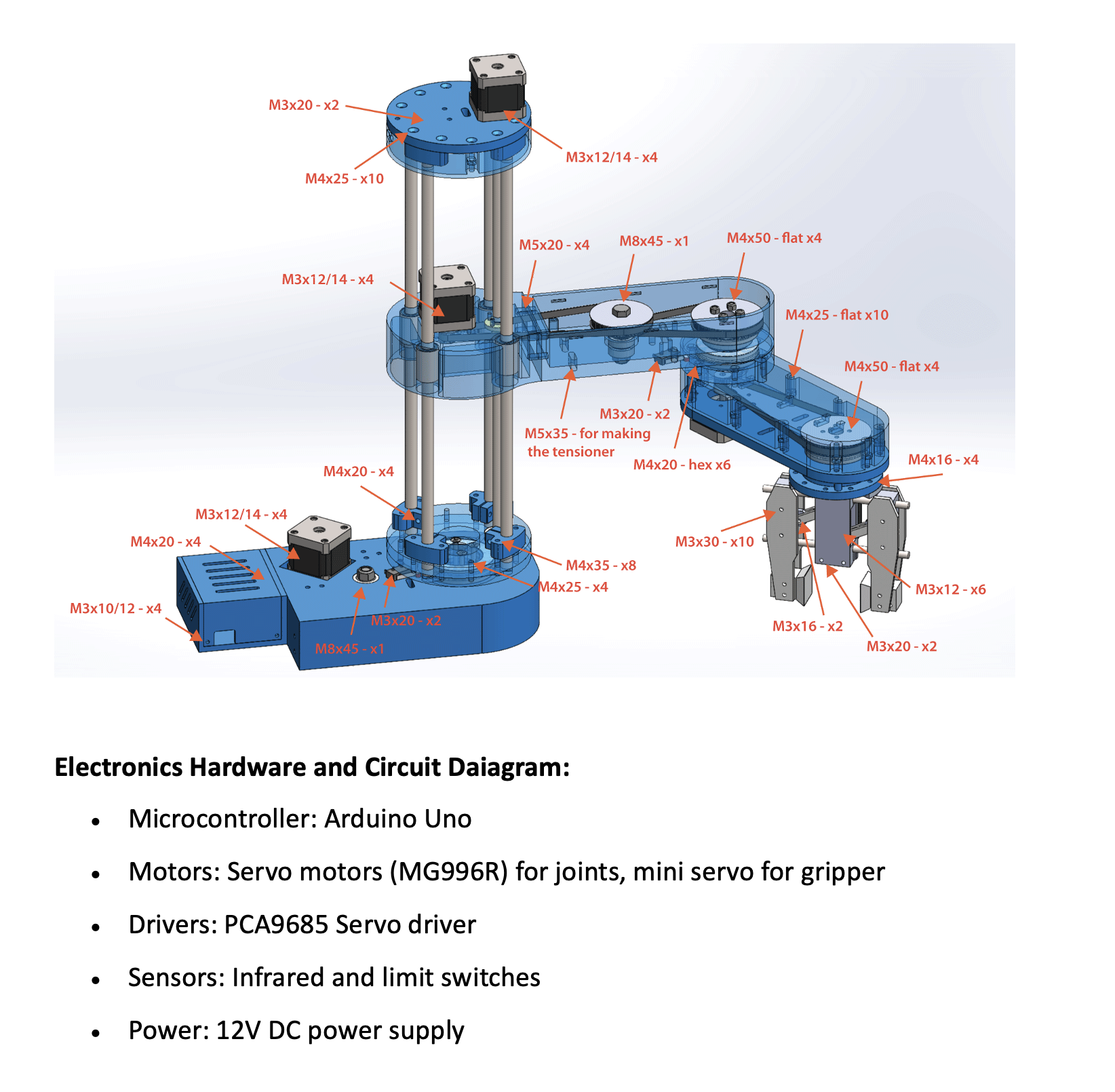
This project presents the design and implementation of a Selective Compliance Assembly Robot Arm (SCARA) optimized for automated pick-and-place operations. Featuring two horizontal revolute joints and a vertical prismatic axis, the manipulator achieves high precision, fast cycle times, and structural rigidity within a defined workspace. Microcontroller-based hardware integrates stepper motors, feedback encoders, and an end-effector gripper, while custom kinematic algorithms drive precise trajectory planning. Experimental testing confirms high repeatability, position accuracy, and efficient payload handling. The implemented SCARA system offers a scalable, cost-effective solution for industrial automation, streamlining tasks like component sorting, assembly line transfer, and automated packaging.
Keywords
SCARA robot
Arduino
raspberry PI
Project Poster
Design and Implementation of Pick and Place SCARA robot